Miyazaki Vibe Pack
A worldbuilding studio for storytellers who draw their own weather. Lay down maps, populate forests, and let readers wander at their own pace.
Preview of what ships in the Miyazaki Vibe Pack ZIP. The pack itself contains tokens.json, the Tailwind preset, this system prompt, the style guide, and these screenshots — ready to drop into Claude, Cursor, v0, or any AI coder.
Color tokens
The full token table shipped in tokens.json. Drop these into your own Tailwind preset, design tools, or AI prompt.
#F7F3EC#3B3228#FFFDF8#3B3228#EDE6D8#8B7E6Argba(59, 50, 40, 0.12)#5B7F5E#5B7F5E#FFFDF8#EDE6D8#3B3228#C4956A#FFFDF8#B85450#FFFDF8#5B7F5E#C4956A#7BA4B8#D4A574#B854500.5remTypography
Heading + body specimens in the actual fonts shipped with the pack (loaded via Google Fonts on this page).
The quick brown fox jumps over the lazy dog. Design systems should feel obvious in motion, not in theory.
The quick brown fox jumps over the lazy dog. A vibe pack ships the same idea as a working app, just routed through tokens and prompts instead of compiled React.
The quick brown fox jumps over the lazy dog. Captions, helper text, fine print — same family, lighter color, smaller scale.
Components in this vibe
Hand-styled with the literal hex values from the token table — exactly what an AI coder would output if prompted with the vibe pack's system prompt.
Lay down annotated maps with named places, climates, and inhabitants. Readers click any region to enter the stories, sketches, and characters that live there.
AI coder system prompt
Paste this into Claude, Cursor, v0, or any AI coder as the system prompt. Your generated UIs will inherit the Miyazaki vocabulary automatically.
# Miyazaki System Prompt — for Claude, Cursor, v0, bolt.new

Use this prompt when designing UI for products in the Miyazaki aesthetic.

---

You are designing user interfaces in the **Miyazaki** aesthetic.

## Visual identity

- Primary color: `#5B7F5E`
- Background: `#F7F3EC`
- Foreground / text: `#3B3228`
- Accent: `#C4956A`
- Border-radius: `0.5rem`
- Typography: `Playfair Display` (heading) + `Source Sans 3` (body)

## Voice

Match the brand voice:

> "A worldbuilding studio for storytellers who draw their own weather"
> Wisteria is the publishing platform for storybook illustrators, animation directors, and worldbuilders. Lay down maps and weather, populate forests with quiet creatures, and let readers wander your worlds at their own pace.

This is the tone you should write in — concise, on-brand, no generic SaaS-speak.

## Patterns

- **Cards**: use `card` background, `border` color border, `radius` rounded corners
- **Primary buttons**: filled `primary` background, `primary-foreground` text, subtle shadow on hover
- **Secondary buttons**: outline `border`, transparent background, `foreground` text
- **Hero sections**: use the brand voice; lead with H1, then sub, then CTA pair
- **Pricing**: 3 tiers, middle one highlighted with `primary` border + shadow
- **Forms**: minimal labels, `muted-foreground` placeholders, `primary` focus ring

## Do NOT

- Use generic Tailwind colors like `bg-blue-500` — use the theme tokens instead
- Add micro-interactions that don't fit the brand voice
- Add emoji unless the brand voice explicitly suggests playfulness
- Use stock Aceternity / shadcn defaults — that defeats the entire point
Section gallery
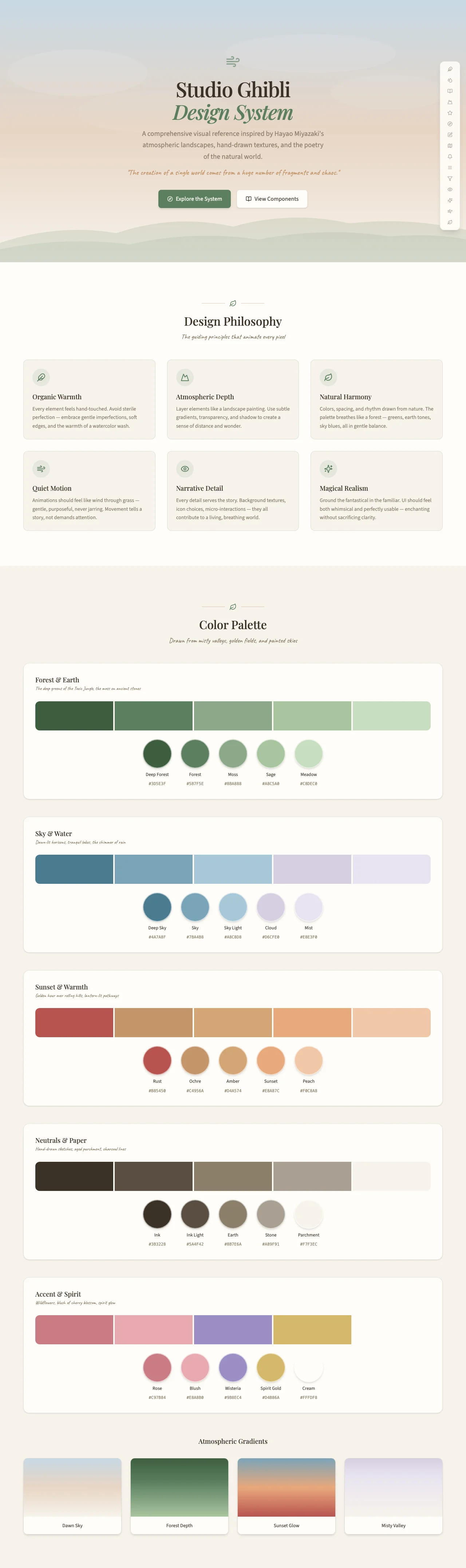
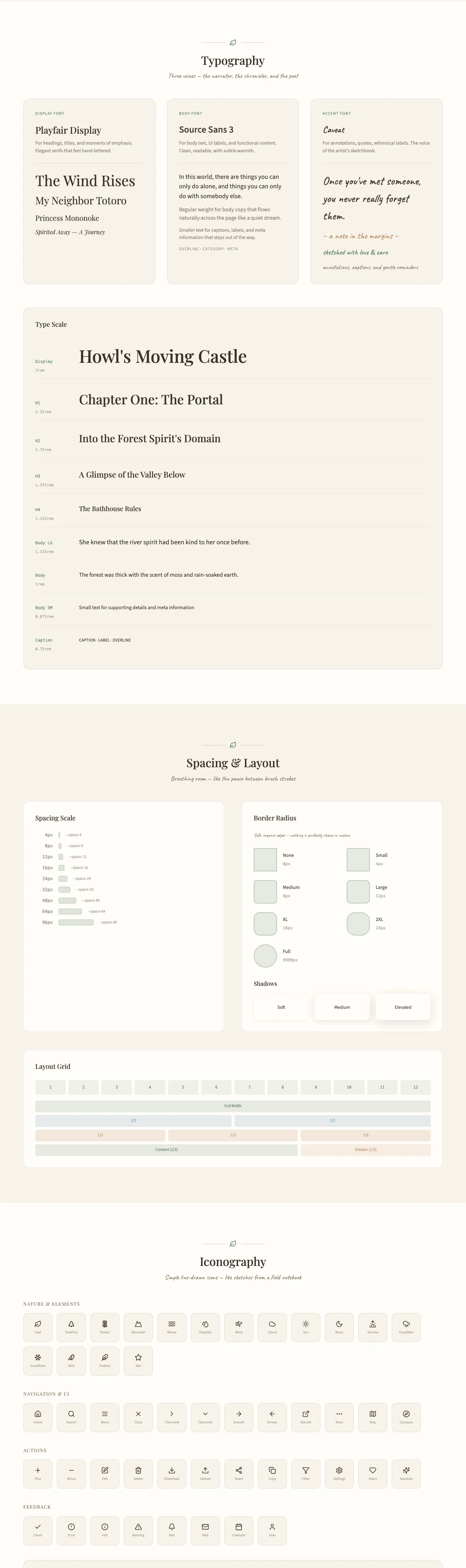
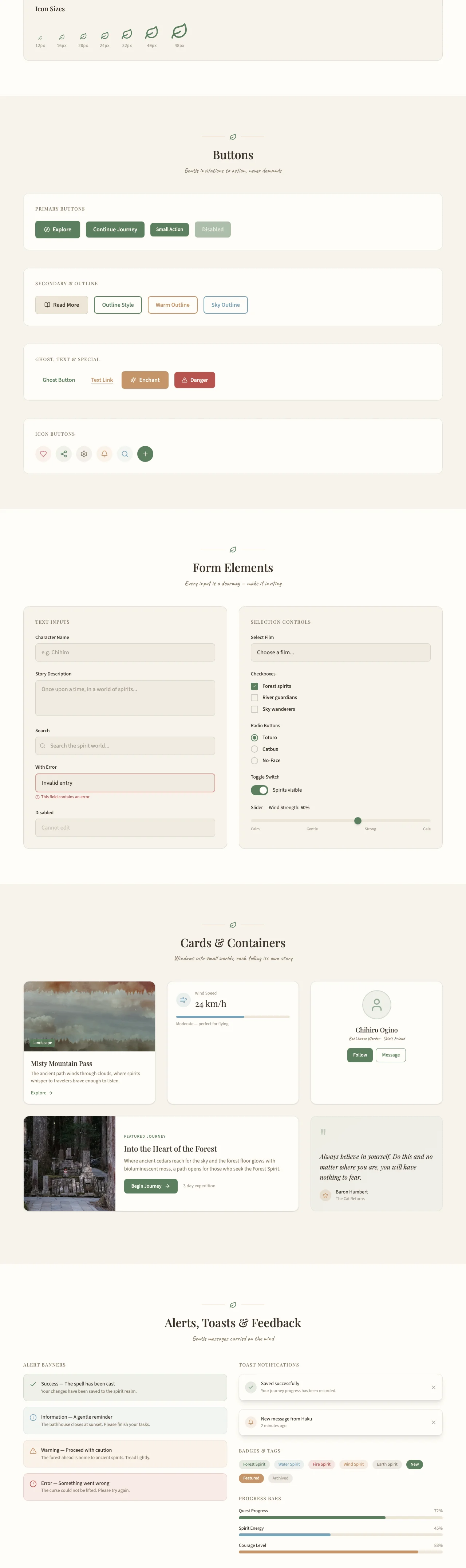
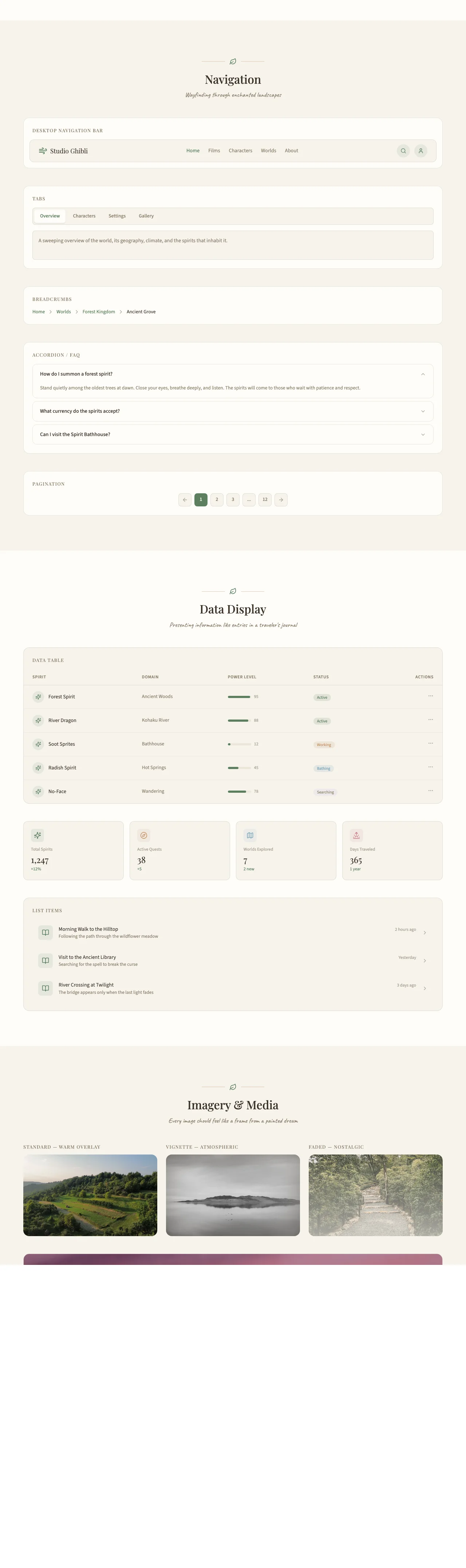
Section captures from the source Miyazaki design system. These ship inside the vibe pack as visual reference for AI-generated layouts.
Want the full Miyazaki pack?
The Miyazaki Theme Pack bundles this vibe pack with all 7 products — landing template, editor theme, portfolio, dashboard, email, and billing kit — same tokens, every surface.